
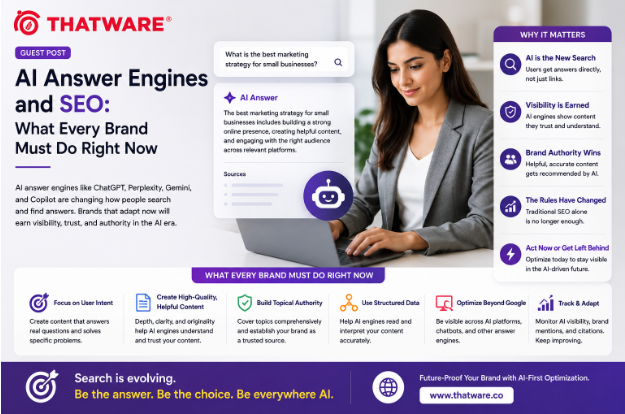
Something shifted quietly in the last eighteen months, and a lot of brands missed it entirely. Not because they weren’t paying attention — but because the change didn’t announce itself with a major algorithm update or a Google blog post. It just… happened. The way search works changed. And the playbook that got you here won’t get you to where you need to be.
AI answer engines are no longer a fringe phenomenon or a tech-enthusiast novelty. They’re mainstream. Perplexity has tens of millions of users. Google’s AI Overviews appear on a significant chunk of all searches. ChatGPT’s search function is being used by people who used to type queries into Google without a second thought. The behavior has shifted, and brands that haven’t noticed are going to feel it in their traffic numbers before they feel it in their strategy meetings.
So what actually needs to change? Let’s get into it.
The Core Problem: Visibility Has a New Definition
For years, “being visible” in search meant ranking in the top three results for your target keywords. The first page was good. The top three were great. The featured snippet was the dream.
That framework still matters — but it’s incomplete. AI answer engines don’t always surface a list of links. They synthesize. They summarize. They produce a response that draws from multiple sources and often doesn’t require the user to click through to any of them. Your brand can be completely absent from that synthesized answer even if you rank #1 for the underlying query. That’s the new visibility gap.
The brands winning right now are the ones that have figured out how to become sources — content that AI systems cite, reference, and paraphrase. That’s a meaningfully different goal than ranking.
What AI Systems Actually Look For
Here’s the uncomfortable truth: AI answer engines tend to favor content that’s authoritative, clear, and specific. Not keyword-dense. Not long for the sake of being long. Not built around search volume and click-through rates.
They favor content that answers questions directly. Content that demonstrates genuine expertise. Content with clear structure — definitions, explanations, examples — that a language model can extract meaning from cleanly. They favor brands that appear across multiple credible contexts, not just their own website.
This is why brand mentions, citations, third-party coverage, and authoritative backlinks still matter — maybe more than ever. A brand that exists only on its own domain is a brand that AI systems have limited reason to trust.
What Brands Should Do Right Now
First, audit your existing content for directness. Go through your top-traffic pages and ask honestly: does this page answer the question it promises to answer? Or does it circle around the answer for 800 words before getting there? AI engines have no patience for preamble.
Second, build topical depth, not just breadth. A brand with twelve blog posts all covering the same topic at surface level looks thin to both Google and AI systems. A brand with comprehensive, layered coverage — foundational explainers, detailed guides, specific use cases, data-backed analysis — signals genuine authority.
Third, get structured. Use schema markup. Write clear headers. Make your content navigable and parseable. An AI system processing your page should be able to identify your main argument, your supporting points, and your key definitions without difficulty.
AI answer engine optimization services are becoming a real category precisely because this work requires strategy, not just execution. Knowing which content to create, how to structure it, and how to distribute authority across a domain is a different skillset than traditional on-page SEO — and brands are increasingly recognizing that gap.
Fourth, invest in off-site authority. Guest content, expert interviews, PR placements, industry citations — anything that builds your brand’s presence in contexts other than your own website. AI systems learn from the broader web. The more credibly your brand appears across that web, the more trustworthy it looks as a source.
The Urgency Is Real
One thing worth saying plainly: the window to get ahead of this is narrowing. Brands that establish themselves as trusted sources in AI-generated answers now will have a structural advantage that’s hard to displace later. The brands that wait until their traffic has already dropped will be playing catch-up in a much more crowded field.
This isn’t about chasing trends. It’s about recognizing that a fundamental shift in how people find information is already underway — and deciding whether to adapt proactively or reactively.
Working with an AI answer engine optimization agency that understands both the technical side (schema, crawlability, structured data) and the content strategy side (authority building, topical depth, entity optimization) is increasingly the fastest way to close the gap.
The brands that move now will be the ones that look prescient in twelve months. That’s not a prediction. It’s just pattern recognition.